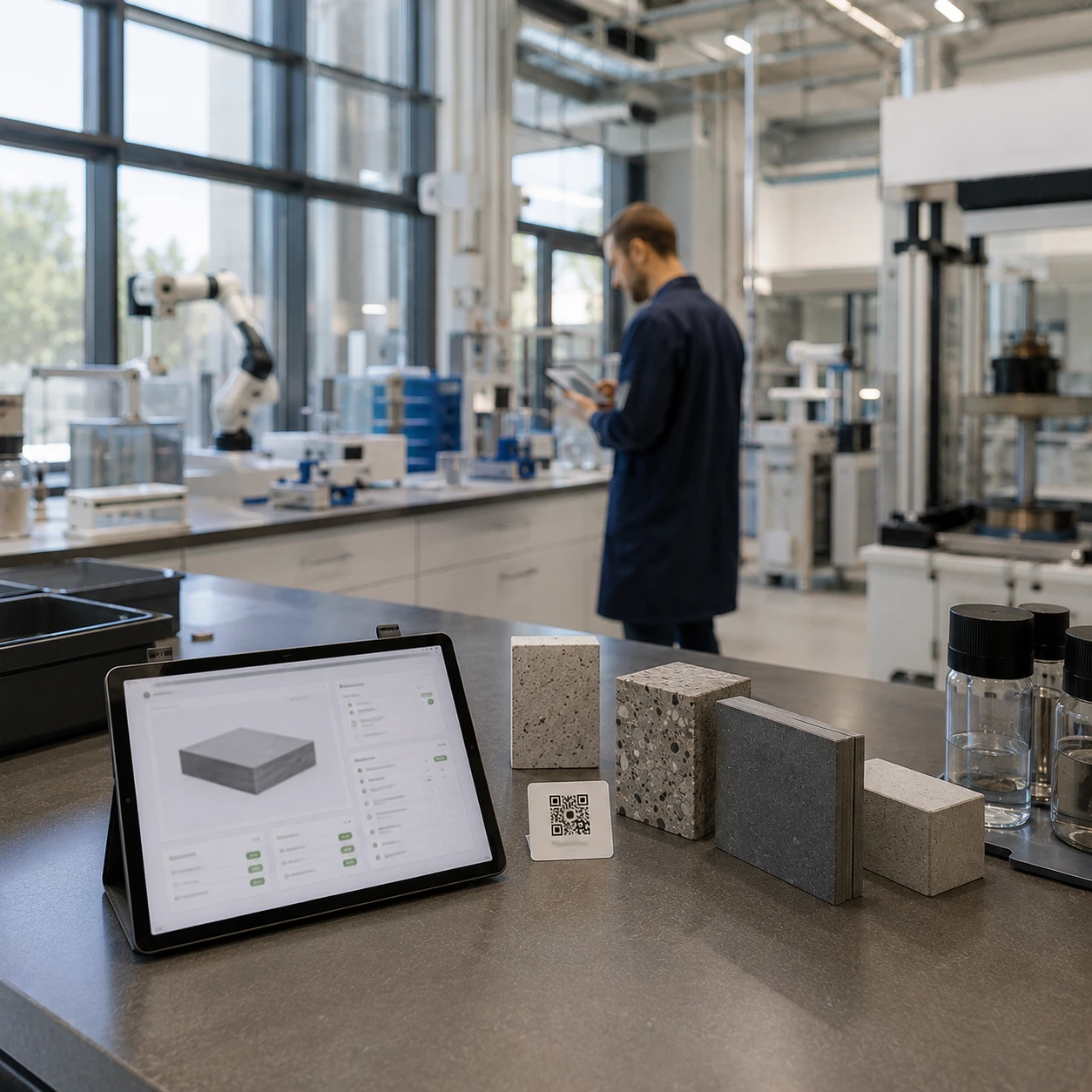
Data audit
We check which DPP-relevant information already exists and where it sits: ERP, PIM, technical data sheets, EPDs, LCAs, supplier data or internal product databases. We assess which data is usable as it stands and which has to be added.
CORE SERVICE DIGITAL PRODUCT PASSPORT
We build DPP data models for construction products that bring EPD life cycle indicators, ERP master data and supply chain information together in one consistent schema. Implementation is possible as the EU CPR and ESPR take effect from 2027.
A construction product is not only made of material. It is also made of information. Which raw materials went into it? Which environmental figures exist? How can the product later be separated, reused or recycled? What evidence is already available? And which data does a customer, planner or public sector client need to be able to assess the product at all?
This is where the Digital Product Passport, or DPP, comes in. It is a structured digital collection of data about a product. Think of it as a digital identity document for the product: all the relevant information gathered in one place, clearly ordered and presented so that it can be read by people and processed by software systems alike.
That includes information on material composition, environmental indicators from LCA or EPD, details on recycling and deconstruction, technical product data, certificates and selected supply chain information. The DPP does not make this data better on its own, but it does make it findable, comparable and usable elsewhere.
For construction products the Digital Product Passport is becoming more relevant through new European rules. The EU Construction Products Regulation and the Ecodesign Regulation matter most here. Both aim to make product information more transparent and usable digitally. From 2027 the roll-out becomes concrete step by step. At the same time many lead planners, public sector clients, large processors and customers subject to the CSRD are already asking for more detailed product data today.
The pressure often comes not directly from an authority but along the supply chain. A large client needs data for a project. The lead planner asks the manufacturer. The manufacturer asks its own suppliers. The requirements travel downwards step by step until smaller and mid-sized manufacturers have to deliver too.
Anyone who only sets up the Digital Product Passport once it becomes mandatory will be working under time pressure and facing considerable cost. Data sources have to be found, responsibilities clarified, ERP systems connected, missing environmental figures added and product data structured. All at once. Starting the preparation earlier lets you build that process under control.
We therefore do not treat the DPP as an isolated IT project. A useful Digital Product Passport starts with one question: which data already exists, and which still has to be built up so it holds? Often the important information is already there, in EPDs, LCAs, technical data sheets, ERP systems, bills of materials, formulations or supplier documents. What matters is assigning and structuring that data cleanly, and not maintaining it twice.
That is exactly where ecoverity comes in. We map existing EPD data points, LCA results and ERP master data onto a DPP structure. In a DPP project we show concretely which data is already usable, what is missing, which interfaces will be needed and what a Digital Product Passport looks like for your product range.
A coming obligation then turns into an orderly start on digital, reviewable and reusable product information rather than a rushed data project. We create clarity before the requirements become binding, and lay the groundwork together so that later DPPs take less effort and stay more consistent.
Your DPP project in 5 steps
We check which DPP-relevant information already exists and where it sits: ERP, PIM, technical data sheets, EPDs, LCAs, supplier data or internal product databases. We assess which data is usable as it stands and which has to be added.
We map the future mandatory DPP fields onto your existing data sources. That builds the bridge between sustainability data, product master data and technical information. The aim is to link existing data cleanly rather than maintain it twice.
We develop a first DPP data model for your product. It defines which information the passport should hold, which fields are mandatory, optional or can be added later, and how the data can be structured technically. The model stays compatible with formats such as JSON or XML and with the EU requirements still to come.
We put the DPP process into practice on the chosen product. We populate the data model with product data, test how usable it is day to day and show how the passport can later be made available to customers, planners or internal teams, for example through a QR code or a system export.
We define how the DPP can be maintained over time. We establish which data can be taken automatically from ERP or PIM systems, which information has to be added manually and how updates run when the product changes.
We check which DPP-relevant information already exists and where it sits: ERP, PIM, technical data sheets, EPDs, LCAs, supplier data or internal product databases. We assess which data is usable as it stands and which has to be added.
Data overview, data sources, priority list for missing data
We map the future mandatory DPP fields onto your existing data sources. That builds the bridge between sustainability data, product master data and technical information. The aim is to link existing data cleanly rather than maintain it twice.
Mapping table, field logic, data source assignment
We develop a first DPP data model for your product. It defines which information the passport should hold, which fields are mandatory, optional or can be added later, and how the data can be structured technically. The model stays compatible with formats such as JSON or XML and with the EU requirements still to come.
Draft DPP schema, data structure, field definitions
We put the DPP process into practice on the chosen product. We populate the data model with product data, test how usable it is day to day and show how the passport can later be made available to customers, planners or internal teams, for example through a QR code or a system export.
Digital Product Passport, QR code and access concept
We define how the DPP can be maintained over time. We establish which data can be taken automatically from ERP or PIM systems, which information has to be added manually and how updates run when the product changes.
DPP pipeline, update process, interface concept
What you actually receive
A complete DPP schema in JSON and XML, ready to connect to the EU CPR and ESPR requirements as soon as the implementing acts are final.
A mapping table linking DPP fields ↔ ERP fields ↔ EPD data points, the bridge between master data and sustainability data.
A DPP for your product, including QR code and data flow diagram.
An overview of all DPP-relevant data from ERP, PIM, EPDs, LCAs and supplier documents, including data source assignment and a priority list.
What the DPP makes possible
A structured DPP brings LCA and EPD data together, ready to feed a well-founded CO₂ reduction strategy.
In one conversation we establish which product data you already hold, where the gaps are and what project scope is realistic.