CORE SERVICE LIFE CYCLE ASSESSMENT

Dependable LCAs as the data basis behind every product assessment

We produce methodologically sound LCAs for bespoke and multi-layer construction products, as the data basis for EPDs, DPPs, PCFs and reduction strategies. Turnaround is about one week, depending on scope and data availability.

ISO 14040 · ISO 14044 · EN 15804+A2 compatible

What is an LCA, and why is it the foundation for everything else?

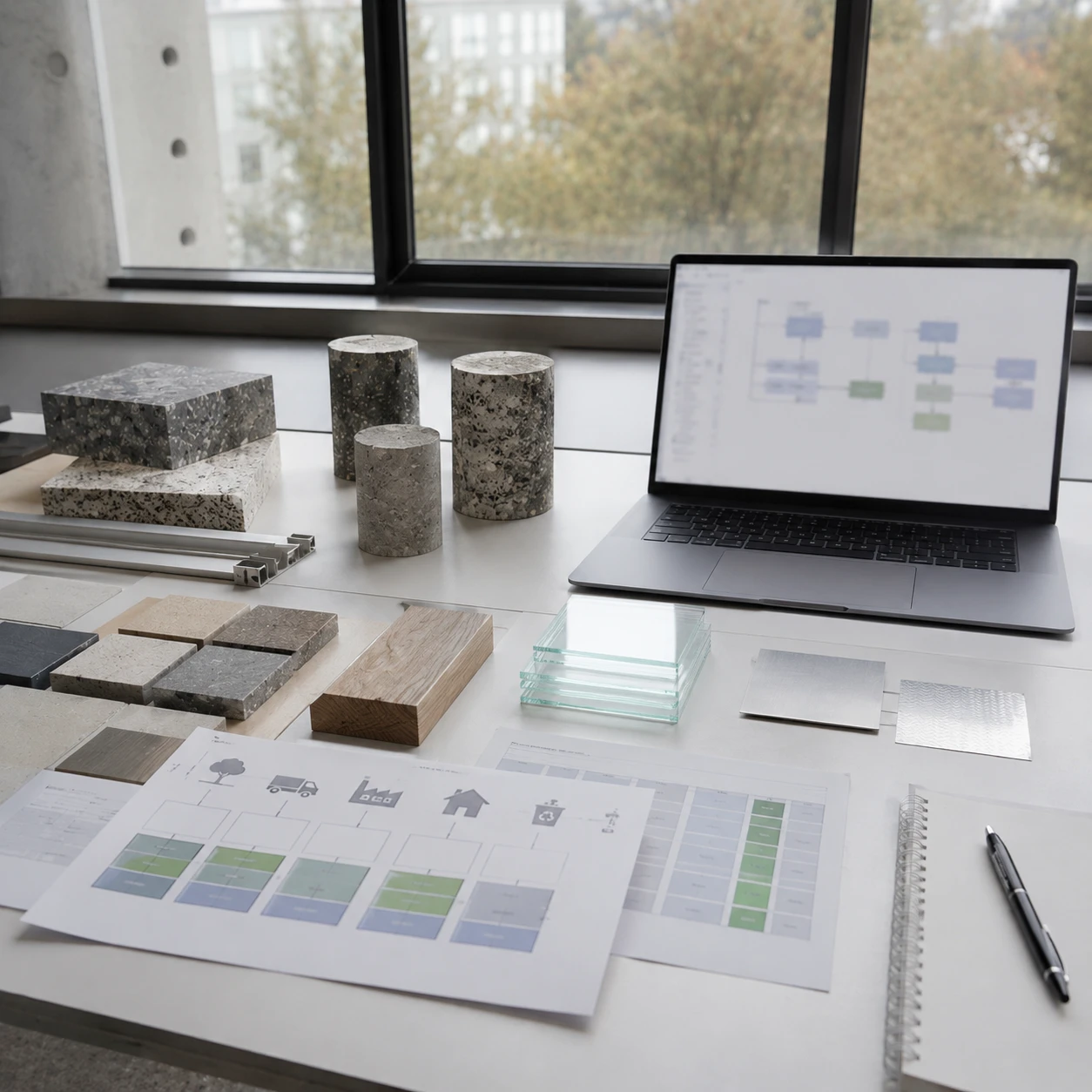
Every construction product has a story: raw materials are extracted, materials processed, components transported, products manufactured, installed, used and eventually disposed of or recycled. A life cycle assessment, or LCA, makes that story measurable. It shows which environmental impacts a product causes across its life, through energy use, raw materials, transport or disposal.

So that this assessment is not arbitrary, it follows clear rules. The international standards ISO 14040 and ISO 14044 set out how an LCA has to be built. Put simply, it has two central parts. The inventory collects what goes into the product and what comes out of it: materials, energy, waste and emissions. The impact assessment then calculates which environmental effects follow from that, such as global warming potential or resource consumption.

An LCA is therefore more than a single calculation. It is the data basis for dependable sustainability assessment. EPDs, product carbon footprints, reduction strategies and many regulatory records all build on it. Calculate it properly once and you have not just a report, but a foundation that can be used again and again.

For manufacturers of construction products this foundation matters more every year. New reporting obligations such as the CSRD require large companies to disclose their sustainability data in far more detail. At the same time they ask their suppliers for exactly that data, above all for so-called Scope 3 emissions, which do not arise inside the company itself but in the supply chain. The EPD to EN 15804+A2 is also becoming standard in tenders, product comparisons and building certification. Anyone who cannot supply sound life cycle data risks a weaker position in tenders, or being dropped from the supply chains of larger customers.

It gets genuinely demanding with complex construction products. A simple, single-phase product can often still be represented with standard data or templates. Multi-layer products, or products with many variants, are a different matter: facade and insulation systems, fire protection products, building services components or functional building elements often combine several materials, functions and processing steps. A standard template is rarely enough here.

This is exactly where ecoverity comes in. We model complex products layer by layer, test assumptions methodically and document decisions so they can be followed. The result is a data basis that works not only for a single EPD, but also for the coming Digital Product Passport and for later PCFs, updates, variants, tenders and reduction measures. A compliance obligation turns into a dependable tool for product development, sales and strategy.

Your LCA project in 6 steps

The route to a standards-compliant life cycle assessment

  1. Kick-off & factory visit

    We start with a shared understanding of the product, its application and the goal. What will the LCA be used for: as an internal basis for decisions, as the foundation for an EPD, or for a PCF? From that we derive the relevant life cycle and the requirements the data has to meet.

    Duration
    About 1 day
    Responsible
    ecoverity + manufacturer
  2. Building the inventory

    We record every relevant input and output along the defined system boundary. For multi-component construction products we structure the material logic so that it can later be checked, updated and reused for variants without guesswork.

    Duration
    About 2 days
    Responsible
    ecoverity
  3. Impact assessment

    We translate the product data into a dependable LCA model and calculate the environmental impacts across the life cycle. The results show how much individual materials, processes or transport steps contribute.

    Duration
    About 2 days
    Responsible
    ecoverity
  4. Interpretation & hotspots

    We analyse which materials, processes or life cycle stages cause the largest environmental impacts, and test how sensitive the results are to assumptions and data uncertainty. That makes it visible where reduction potential sits and which levers actually matter.

    Duration
    About 1 day
    Responsible
    ecoverity
  5. Report & validation

    We document the goal, method, data sources, assumptions and results in an LCA report to ISO 14040 and ISO 14044. Before sign-off we review the modelling critically in-house and prepare the documents for follow-on projects.

    Duration
    About 1 to 2 days
    Responsible
    ecoverity
  6. Follow-on & reuse

    The LCA does not end with a report. We turn the results into a data basis that connects to further sustainability evidence. On request we keep the data set current and extend it when the product changes, new variants appear or regulation shifts.

    Duration
    Ongoing
    Responsible
    ecoverity
  1. 01

    Kick-off & factory visit

    We start with a shared understanding of the product, its application and the goal. What will the LCA be used for: as an internal basis for decisions, as the foundation for an EPD, or for a PCF? From that we derive the relevant life cycle and the requirements the data has to meet.

    Duration

    About 1 day

    Responsible

    ecoverity + manufacturer

    Deliverable

    Binding scope, life cycle boundary, data requirement list

  2. 02

    Building the inventory

    We record every relevant input and output along the defined system boundary. For multi-component construction products we structure the material logic so that it can later be checked, updated and reused for variants without guesswork.

    Duration

    About 2 days

    Responsible

    ecoverity

    Deliverable

    Inventory data set, data gap overview, material and process model

  3. 03

    Impact assessment

    We translate the product data into a dependable LCA model and calculate the environmental impacts across the life cycle. The results show how much individual materials, processes or transport steps contribute.

    Duration

    About 2 days

    Responsible

    ecoverity

    Deliverable

    Impact assessment report, LCA model, results by life cycle stage

  4. 04

    Interpretation & hotspots

    We analyse which materials, processes or life cycle stages cause the largest environmental impacts, and test how sensitive the results are to assumptions and data uncertainty. That makes it visible where reduction potential sits and which levers actually matter.

    Duration

    About 1 day

    Responsible

    ecoverity

    Deliverable

    Hotspot report, sensitivity analysis, prioritised reduction options

  5. 05

    Report & validation

    We document the goal, method, data sources, assumptions and results in an LCA report to ISO 14040 and ISO 14044. Before sign-off we review the modelling critically in-house and prepare the documents for follow-on projects.

    Duration

    About 1 to 2 days

    Responsible

    ecoverity

    Deliverable

    Validated LCA report, data basis ready for review

  6. 06

    Follow-on & reuse

    The LCA does not end with a report. We turn the results into a data basis that connects to further sustainability evidence. On request we keep the data set current and extend it when the product changes, new variants appear or regulation shifts.

    Duration

    Ongoing

    Responsible

    ecoverity

    Deliverable

    LCA data basis in the ecoverity system, update structure

What you actually receive

ecoverity's service promise

What the LCA makes possible

Services that build on the LCA

A properly built LCA becomes the foundation for PCFs, EPDs and DPPs.

  1. STEP 01

    Methodology

  2. STEP 02

    Documentation

  3. STEP 03

    Strategy

Common questions about LCA

What makes an ecoverity LCA different from other providers?
An ecoverity LCA combines rigorous modelling with a lean, digital project process. We do not work from rigid templates. Instead we structure your product data so that bespoke construction products, variants and special cases can all be represented cleanly. That relies on internal automation, standardised data logic and close coordination with your team. The process stays efficient and easy to follow, with a person to talk to throughout.
Which databases do you use?
We work primarily with the current version of ecoinvent. For construction product data we add suitable data sets per project, for example from ÖKOBAUDAT or other recognised sources. Which database fits depends on what the LCA will later be used for. If an EPD to EN 15804+A2 is planned, we make sure while building the inventory that the data basis will connect cleanly and stay consistent with the requirements of the relevant programme operator.
How long does an LCA take?
For a clearly bounded cradle-to-grave scope we usually reckon with 1 to 2 weeks from data release. The biggest time factor is normally not the modelling but the availability and quality of the input data. That is why we set out early which information is needed, which data is realistically available and which assumptions have to be documented properly.
What does an LCA cost?
The price depends on product complexity, the number of variants and how deep the sensitivity analysis goes. We are happy to send you our price list on request. In a first conversation we can set the scope and prepare an individual, non-binding quote for you.
What happens if rework or changes become necessary?
Rework within the agreed LCA project is included in the price, including when it comes up later through queries, internal review or follow-on use. That covers corrections, methodological explanations, smaller adjustments or additional evidence for the existing calculation. If the product itself changes, through a new formulation, different suppliers, new production data or additional variants, the LCA data basis has to be updated technically. That does not require a completely new LCA, but a targeted follow-on assignment building on the existing model.

Let us work out together how deep your LCA needs to go.

In one conversation we establish what you need the LCA for, which life cycle stages matter and how much detail is genuinely useful for your product.